



Porcelain Laminate Veneers in Antalya
Redesign Your Smile with Minimally Invasive Approaches That Respect Natural Tooth Structure
A Paradigm Shift in Cosmetic Dentistry
As the most striking and dynamic component of facial aesthetics, the smile is a fundamental element that directly determines an individual’s self-confidence in social interactions. Modern cosmetic dentistry practices today go beyond merely offering visual improvements, addressing function, biological compatibility, and phonation as a unified whole. Porcelain laminate veneers—one of the most sophisticated products of this holistic approach—are offered to our patients at our clinic in Antalya as a flawless synthesis of art and science.
In traditional dentistry, meeting aesthetic expectations often required the removal of significant amounts of tooth structure from all surfaces of the teeth. However, thanks to revolutionary advancements in today’s adhesive technologies, biomimetic (nature-inspired) principles have come to the forefront. Laminate veneers are ultra-thin porcelain restorations applied to the outer surface of the tooth to mimic the enamel layer, rather than reducing the tooth entirely. Our core philosophy is to create a new enamel surface that is optically flawless, translucent, and mechanically highly resistant, while preserving the existing natural tooth structure to the greatest extent possible.
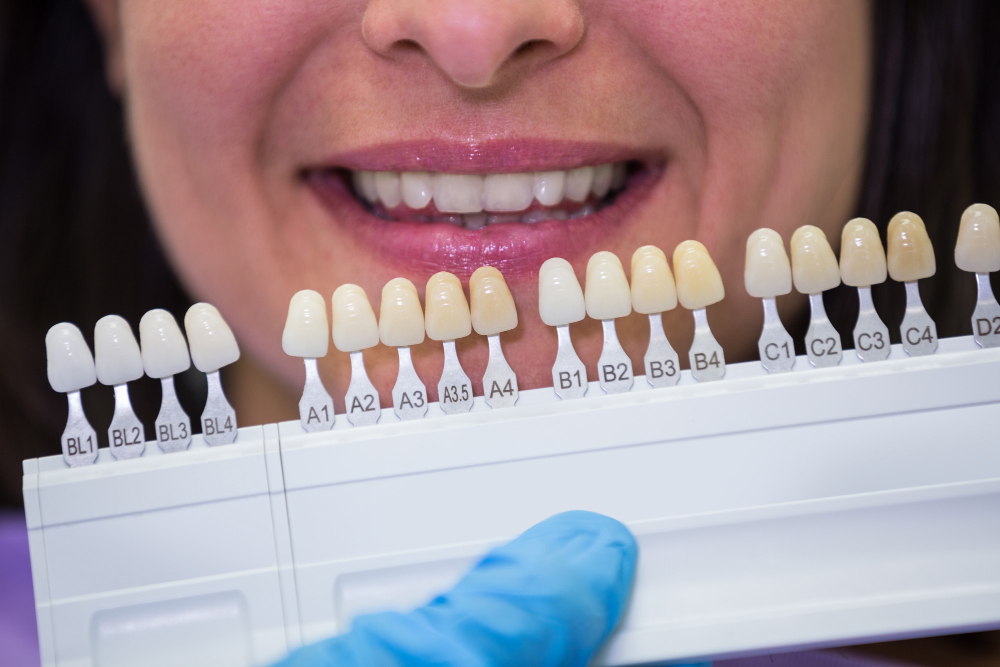
In our clinical practice, veneer treatment is not merely a cosmetic procedure; it is a comprehensive restorative process in which the patient’s facial proportions, lip dynamics, gum contours, and even skin tone are calculated down to the millimeter. This meticulous process ensures that the restoration retains its original luster and function for decades.
Who Are Laminate Veneers Suitable For? (Indications)
Although porcelain veneers are considered the pinnacle of cosmetic dentistry, proper case selection is essential. Restorations performed with the wrong indication can fail within a short period of time. At our clinic, we determine whether our patients are suitable candidates for veneer treatment through a detailed clinical and radiographic examination.
- ✓Stubborn Discoloration: This is the definitive solution for teeth discolored due to tetracycline (antibiotic) use, severe fluorosis cases, or teeth that have darkened following root canal treatment and cannot be whitened with standard bleaching procedures.
- ✓Closing Diastemas: This is an ideal solution for patients who do not wish to undergo orthodontic treatment (braces) to close the gaps (diastemas) between widely spaced teeth in a way that is both aesthetic and anatomically sound.
✓Malformations and Fractures: It restores the tooth’s morphology in cases of microdontia (teeth smaller than normal), peg-lateral (wedge-shaped lateral incisors) anomalies, or teeth with enamel fractures resulting from trauma. - ✓Mild Crowding (Anterior Crowding): In cases of mild misalignment, it provides an “instant orthodontics” effect as a quick alternative to orthodontic treatment.
The Importance of Periodontal Health and Pre-Treatment Preparation
The gums (gingiva) form the foundation of an aesthetic restoration. Applying an aesthetic porcelain restoration to bleeding, swollen, or inflamed gums is medically unacceptable. Therefore, if the patient exhibits any signs of gum disease (periodontitis) prior to treatment, this condition must first be completely resolved through professional periodontal treatments (scaling and root planing). Transition to white aesthetics (porcelain restoration) is not made without first ensuring pink aesthetics (gum health and symmetry). When a healthy biological width is achieved, laminate restorations remain in perfect harmony with the gums for a lifetime.
Which Type of Restoration Should You Choose? Materials Science
One of the most important questions our patients frequently ask is which type of veneer or material is most suitable for them. In dentistry, there is no single "best" material; there is only the "right" material determined by the patient's bite dynamics (occlusion), parafunctional habits (teeth grinding), and aesthetic expectations.
Steps to Perfection: The Laminate Treatment Workflow
At our clinic in Lara, Antalya, the laminate treatment process is a journey that leaves no room for surprises—it is fully digital, predictable, and shaped by the patient’s active participation. In smile designs that typically cover the aesthetic zone, the number of teeth included in the treatment plan ranges from 8 to 10, depending on the patient’s lip structure and smile width. When lower jaw aesthetics are also considered, this number can increase to as many as 20.
Step 1: Digital Analysis and Smile Design
During your first session, we’ll take photos and videos of you in our professional studio. Using digital intraoral scanners, a 3D model of your teeth is transferred to the computer. Using specialized software, a personalized smile design is created that aligns with the golden ratios of your face and harmonizes with the dynamics of your lips.
Step 2: Mock-up and Aligning Expectations
The digital design is transformed into a “wax-up” (wax model) in the laboratory. Using a silicone mold taken from this model, a temporary resin material is applied directly to your mouth. This process is called a “mock-up.” Without any work being done on your teeth, you can see the length, shape, and appearance of the final restoration in real time. The procedure will not begin without your approval.
Step 3: Minimally Invasive Preparation and Digital Impression
Under local anesthesia, painless, millimeter-precise adjustments are made to only the front surfaces of the teeth (typically 0.3–0.5 mm). Then, instead of traditional impression materials, your digital impression is transmitted to the lab in seconds using state-of-the-art optical scanners that do not cause nausea. Your temporary laminates are bonded during the same session, allowing you to continue your daily life without interruption.
Step 4: Isolation and Adhesive Cementation (Bonding)
Approximately 5–7 days later, the veneers—fabricated in the laboratory from e-max or feldspathic porcelain—are tried in the clinic. If the fit and color are perfect, the bonding procedure begins. This stage is extremely critical; absolute isolation is ensured by using a “Rubber Dam” to completely remove saliva and moisture from the environment. The laminates are integrated into the tooth one by one using chemical adhesive protocols.
Lifespan of Veneers and Long-Term Maintenance Standards
Numerous clinical studies and evidence-based medical data indicate that porcelain veneers—when planned with the correct indications, bonded in accordance with isolation protocols, and properly maintained by the patient—have a success rate of over 95% for the first 10 years. With an effective dental care routine, these restorations can serve in the mouth without issues for 15 years or much longer.
The long-term success of your veneers depends directly on your daily habits. All the rules that apply to your natural teeth also apply to veneers. Porcelain itself does not decay or discolor (tea, coffee, and tobacco do not stain porcelain laminates); however, the underlying tooth structure is susceptible to decay. Therefore, impeccable oral hygiene is essential.
- Teeth should be brushed at least twice a day using a soft-bristled toothbrush and a non-abrasive toothpaste.
- The use of dental floss or an interdental brush is essential to prevent plaque buildup along the laminate edges. Regular cleaning helps maintain gum health.
- Avoid parafunctional habits that can even break natural teeth, such as cracking nuts or walnut shells, biting pencils, biting nails, or tearing open packages.
- For patients diagnosed with teeth grinding (bruxism) during sleep, custom-made transparent night guards (occlusal splints) are prepared to protect the laminates, and their use is mandatory.
Turkey on the International Stage: Laminate Treatment in Antalya
Turkey is one of the undisputed leaders in global medical tourism, thanks to its advanced technological infrastructure, clinics meeting European standards, and highly experienced dentists, particularly in the field of cosmetic dentistry. Thousands of patients from abroad choose our country for the “laminate veneers in Turkey” concept, which offers both quality and cost-effectiveness.
Located in the Lara district of Antalya, the heart of the Mediterranean, our clinic offers international patients not only superior medical care but also a complete experience. During your 5- to 7-day treatment stay, you can relax on Antalya’s crystal-clear beaches, explore its historic charm, and return home with a brand-new, captivating smile. Our clinic’s international patient department handles all transfers and appointment scheduling on your behalf, ensuring you enjoy your treatment process with the comfort of a vacation.